
7 Warning Signs
You Need a Root Canal
Immediately
Your tooth is trying to tell you something. These are the signs that mean the infection inside is serious enough that waiting will make treatment harder, more expensive, and more painful.
Most people who need a root canal do not suddenly develop severe pain overnight. The warning signs build up over days or weeks. The problem is that many patients either do not recognise them or hope the pain will go away on its own. It very rarely does.
A dental infection does not heal without treatment. The longer it is left, the deeper the infection spreads, the more bone it destroys, and the harder it becomes to save the tooth. In some cases a tooth that could have been saved with a straightforward root canal ends up needing to be taken out entirely because too much time passed.
These 7 warning signs are the ones that tell you the situation has moved beyond a wait-and-see approach. If you recognise any of them, booking a dental examination quickly is the right decision.
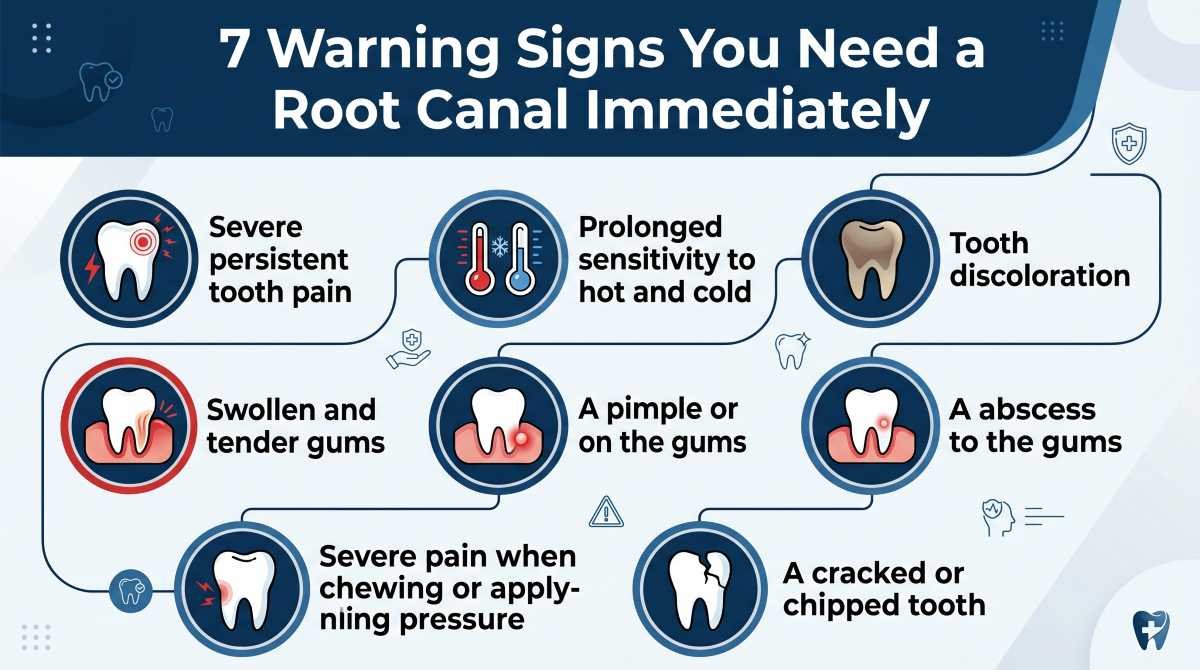
The 7 Warning Signs
This is the most common reason patients eventually come in for a root canal. The pain is often described as a deep, throbbing ache that comes on without a clear trigger. Sometimes it starts as occasional discomfort that you can push through, then becomes something you cannot ignore. Other times it is constant from the beginning.
This kind of pain happens because the soft tissue inside the tooth, which contains nerves and blood vessels, has become infected or severely inflamed. The body is sending pain signals to tell you something is wrong deep inside the tooth.
What distinguishes this from a normal toothache: ordinary sensitivity or mild discomfort can come and go with certain foods or temperatures. But pain that throbs on its own, wakes you at night, radiates toward your jaw or ear, or simply does not clear up after a day or two is pointing to something deeper. Over-the-counter pain relief may reduce it temporarily, but it will not fix the underlying problem.
If biting or chewing on a particular tooth causes a sharp, sudden pain, or a lingering ache that builds under pressure, this is a serious warning sign. It means the tissue around the root of the tooth has become inflamed and is reacting to the force of chewing.
In early stages, the pain might only happen with harder foods or if you press directly on the tooth. As the infection grows, even light biting or the pressure of bringing your teeth together can cause significant discomfort. Some patients start unconsciously chewing only on one side of their mouth to avoid it, which is itself a sign that something is wrong.
This is different from a cracked tooth or a loose filling, though both can feel similar. A dental examination and X-ray are needed to tell the difference, which is exactly why this symptom should be assessed rather than managed around.
Almost everyone has brief sensitivity to cold at some point. That is normal. What is not normal is when the discomfort from a cold drink or hot food continues for 30 seconds, a minute, or longer after you have swallowed. That lingering, slow-fading ache is your tooth telling you the nerve inside is in trouble.
Healthy teeth respond briefly to temperature and recover quickly. An inflamed or infected nerve cannot settle down properly. It stays agitated, which is why the sensation takes far longer to fade than it should. In later stages, heat tends to cause more intense pain than cold, and some patients find that rinsing with cold water is the only thing that provides temporary relief from a hot drink.
That pattern specifically, being set off by heat and temporarily relieved by cold, is a well-known sign that the nerve inside the tooth is severely inflamed and a root canal is almost certainly needed.
When an infection forms inside a tooth, it does not stay contained forever. It spreads down through the tip of the root and begins to affect the bone and gum tissue around it. The result is swelling, tenderness, or a feeling of puffiness in the gum near that particular tooth.
The swelling may be subtle at first, just a feeling that the gum is slightly raised or tender when you touch it. Over time it can become more visible, like a rounded, soft lump in the gum. Sometimes the area aches on its own. Sometimes it is only tender to touch.
If the swelling spreads to your face, jaw, or neck, this is a dental emergency. Facial swelling from a tooth infection can indicate that bacteria are spreading beyond the mouth into deeper tissue spaces. This situation requires same-day care without question.
A small pimple-like bump that appears on the gum near a tooth, then disappears for a while, then comes back, is not a coincidence and is not a normal gum problem. It is called a dental sinus tract, a small channel that forms when the body tries to drain pus from an infected tooth root to the surface of the gum.
The reason it seems to come and go is that when the channel successfully drains some of the built-up infection, the pressure reduces and the bump shrinks. Then infection rebuilds, the bump returns. This cycle of appearing and disappearing can repeat for weeks or months, and many patients mistake it for a minor gum irritation or a mouth ulcer.
It is neither. It is a sign of an active, ongoing infection inside the tooth. The fact that the body is draining it does not mean the infection is clearing. The infection will continue until the tooth is treated. And while this draining process reduces the acute pain for a time, it means the infection has been spreading through the bone for that entire period.
Healthy teeth have a consistent colour. If one tooth has gradually become grey, brown, or significantly darker than its neighbours, this is often a sign that the tissue inside the tooth has died or is in the process of dying.
This happens because when the blood supply to the inner tissue of the tooth is cut off, whether from a deep infection, physical trauma, or a crack, the tissue starts to break down. As it does, it releases compounds that stain the inner walls of the tooth from the inside out, which is why the discolouration appears gradually and cannot be addressed by whitening.
This sign is particularly easy to miss because it develops slowly and there may be little or no pain associated with it, especially if the nerve has already died. Absence of pain does not mean the tooth is fine. An X-ray is the only way to know what is happening at the root level.
Not every cracked tooth needs a root canal. A small surface chip without symptoms often just needs smoothing or a filling. But when a crack runs deep enough to reach the inner part of the tooth, it creates a direct pathway for bacteria to enter. Once bacteria reach the inner tissue, infection follows.
The signs that a crack has gone deep enough to affect the tooth internally are: pain when you release biting pressure rather than when you apply it, sensitivity that lasts after the temperature trigger is removed, intermittent sharp pain with no consistent trigger, or a crack that you can feel with your tongue but that seems to run down into the gum line.
Cracks that extend below the gum line are a particular concern because they can sometimes make the tooth unsaveable even with root canal treatment. This is one reason why a cracked tooth with symptoms should never be left untreated for long. The earlier it is assessed, the more options are available.
What Happens If You Ignore These Signs
Tooth infections do not stop growing when you stop noticing the pain. In fact, one of the most misleading things about dental infections is that they can temporarily become quieter when the nerve inside the tooth dies. The pain reduces because the signalling nerve is no longer functioning. The infection does not reduce. It continues spreading.
Early stage: the warning signs appear
Pain, sensitivity, swelling, or a bump on the gum begins. This is when root canal treatment is most straightforward, most comfortable, and most likely to save the tooth completely.
Infection grows and spreads to surrounding bone
The infection spreads beyond the root tip into the surrounding jawbone, forming a dental abscess. Bone begins to be destroyed. Treatment becomes more involved but the tooth is usually still saveable.
Pain temporarily reduces when the nerve dies
Many patients mistakenly believe the tooth has healed at this point. It has not. The infection is still present and still active. It is just no longer causing pain because the nerve that was signalling pain is no longer working.
Significant bone loss around the root
Without the pain signal, patients often continue to wait. During this time the infection silently destroys more bone around the root. Root canal treatment is still possible in many cases but the outlook is less certain and treatment is more complex.
Tooth becomes unsaveable or infection spreads to face
In the worst cases, the tooth must be extracted because there is not enough healthy structure left to support it. In rare but serious cases the infection spreads to the face, jaw, or airway, requiring hospital treatment. This stage was entirely preventable by acting at the first warning signs.
When You Should Seek Care Today Without Waiting
While all 7 warning signs above mean you should book a dental appointment soon, some situations mean you should seek care on the same day. Do not wait for a scheduled slot if any of the following apply to you.
Seek same-day dental care if you have any of these
- Facial or jaw swelling that is spreading or getting worse
- Difficulty swallowing or breathing along with dental pain
- Fever above 38 degrees Celsius alongside tooth pain or swelling
- Pain so severe that over-the-counter painkillers are not controlling it
- A dental abscess that appears to be growing rapidly
- A tooth knocked out or badly broken with exposed nerve
Book within 2 to 3 days if you have any of these
- A toothache that has been present for more than a few days
- Lingering sensitivity to heat or cold after eating or drinking
- A bump on the gum near a tooth that keeps coming back
- A tooth that has become darker than the others
- A crack or chip in a tooth that is causing any pain or sensitivity
- Gum swelling or tenderness near one specific tooth
What Root Canal Treatment Actually Involves
Many patients delay seeking help because they are afraid of the treatment itself. It is worth being direct about what root canal treatment actually involves, because fear of a procedure is not a good reason to allow an infection to spread.
Root canal treatment is done under local anaesthesia. The area around the tooth is numbed before anything else happens. Once it is fully numb, most patients feel pressure and movement but not pain. The procedure involves removing the infected inner tissue of the tooth, cleaning the space inside thoroughly, and sealing it so infection cannot return. In most straightforward cases this is completed in one or two appointments.
The American Association of Endodontists reports that patients who have had a root canal are four to six times more likely to describe it as painless compared to patients who have not had one. The infection before treatment is almost always more painful than the treatment itself.
For a full, honest explanation of what to expect before, during, and after treatment, see our detailed guide on whether root canal treatment is actually painful. For information on treatment costs and what happens at a consultation in Jamshedpur, see our page on root canal treatment in Jamshedpur.
Frequently Asked Questions
What are the warning signs you need a root canal?+
The 7 main warning signs are: a toothache that keeps coming back or does not go away, pain when biting or chewing, sensitivity to heat or cold that lingers for more than a few seconds, swollen or tender gums near one tooth, a pimple-like bump on the gum that returns repeatedly, a tooth turning noticeably darker than the others, and a deep crack or chip in a tooth that is causing pain or sensitivity. Any of these should be assessed by a dentist without delay.
Can a tooth infection go away on its own?+
No. A tooth infection does not resolve without treatment. The pain may seem to reduce or disappear temporarily if the nerve inside the tooth dies, but the infection continues to be present and to spread to the surrounding bone. Without treatment the situation will get worse, not better. The tooth may eventually become unsaveable, and in serious cases the infection can spread to the face, jaw, or deeper structures of the neck.
Is root canal treatment painful?+
Modern root canal treatment is done under local anaesthesia so you should feel pressure and movement but not sharp pain. Most patients say the procedure was far easier than they expected. The discomfort you feel from the infected tooth before treatment is typically the worst part, not the treatment itself. For a full breakdown of what patients actually experience, see our guide on whether root canal treatment is painful.
How urgent is a root canal?+
If you have facial swelling, a fever, or severe pain that painkillers are not controlling, seek dental care the same day. For warning signs such as a persistent toothache, lingering sensitivity, or a bump on the gum, book an appointment within a few days rather than waiting weeks. The earlier an infected tooth is treated, the simpler, more comfortable, and more affordable the treatment tends to be. Delay consistently leads to more complex situations.
What happens if you delay a root canal?+
Delaying root canal treatment allows the infection to spread to the surrounding bone and neighbouring teeth. The tooth becomes increasingly painful, then temporarily quieter when the nerve dies, creating a false impression that things have improved. In reality the infection continues silently destroying bone. Eventually the tooth may become unsaveable and need extraction. Replacing a lost tooth with an implant or bridge is significantly more expensive and more involved than a root canal while the tooth can still be saved.
Can I take painkillers and wait to see if the pain improves?+
Painkillers can reduce your discomfort temporarily but they do not treat the infection and they do not stop it from spreading. Using painkillers to manage dental pain is reasonable while you arrange an appointment, but it should not replace booking one. If your pain is severe enough that you are relying heavily on painkillers, that itself is a sign you need to be seen quickly. Pain reducing after you take medication is not the same as the problem resolving.
Is it better to extract the tooth than have a root canal?+
If the tooth can be saved, keeping your natural tooth is almost always the better outcome. Extracting a tooth leads to a gap that causes neighbouring teeth to shift, bone to shrink at the site, and chewing forces to redistribute in ways that affect your bite. Replacing the missing tooth with a dental implant costs significantly more than root canal treatment. Extraction is recommended only when the tooth is too damaged to be saved.
Recognise any of these signs? Act before it gets harder to treat.
The earlier a tooth infection is treated, the simpler the procedure, the better the outcome, and the lower the cost. Alam Dental Care and Implant Center in Jamshedpur is led by Dr. Shahbaz Alam (BDS, MDS) with a strong focus on saving natural teeth wherever clinically possible.